
Great humorous periodic table of SL abbreviations from Metaversally Speaking blog
***Imported from old blog***
Great humorous periodic table of SL abbreviations from Metaversally Speaking blog
***Imported from old blog***

The Augustine Commission has released its summary report on the future of US manned spaceflight. The key points appear to be:
Looking to commercial contractors to do the lift to orbit is a nice step - but:
Be interesting to see what extra detail/decisions there are in the final version.
***Imported from old blog***
I've started work on a pet Futurology project called Five by Five - five themes over the next five half-centuries.
As a first element I've just updated my future timeline - mainly focussed on space exploration and AI development. Other issues like poverty. the environment and politics will be added as part of the larger project.
BTW the wiki that the timeline on is one of the reasons there are less posts to the blog - the wiki is a better tool for some of the writing I'm doing at the moment - and easier to use from the iPhone!
***Imported from old blog***
http://pipes.yahoo.com/bounder/birminghamlocalblogs
and a description of how it was done
http://www.jonbounds.co.uk/blog/645/hyperlocal-news-wire/
Nice work
***Imported from old blog***

In response to one of the comments on my Semantic Web post I dug up the roadmap diagram I did 2 years ago. I still think the areas and steps are pretty valid, but we've not made as much progress in the last 2 years as I'd thought we would. Really little has changed since then, although signs are that by 2010 we might actually start tikcing some of the things off. I'll try and find time to update the whole docuemnt this came from.
***Imported from old blog***
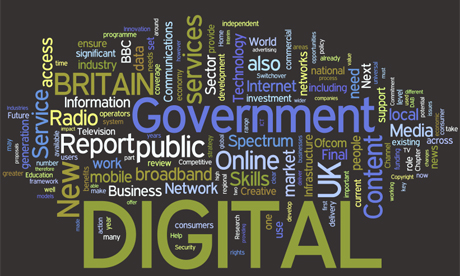
Wordle from Guardian
Underwhelmed by the Digital Britain report, but still a pity I won't be able to make the regional launch at the ICC today. The Wordle above nicely summarises the issues:
- dominance of Government
- Radio far stronger than TV or Internet (talk about aiming low)
- Ditto spectrum
- No mention of web 2.0 brands, technologies or principles
Overall it looks more like an "old media" report than a "new media" report, failing to grasp the possibly seismic change in communications that high speed broadband and mobile broadband could bring, and the changes in consumption (and production) patterns already happening.
Perhaps a better approach would have been a 3 part one:
- tidying up the old guard (radio, spectrum, BBC, Channel 4)
- rapid build-out of a next-gen infrastructure
- exploiting that infrastructure
***Imported from old blog***
One of the things that has struck me over the last few weeks in discussions about where virtual worlds are going is that we are in danger of making the same mistake made by application development and the web, by concentrating on the wrong thing. With virtual worlds, and the moves towards interoperability and standards, there is a real opportunity to get things right first time.
The "mistake" is that we tend to concentrate on the visual. It's only natural, it's probably our most powerful sense and the one that most of us would least wish be without - and hardly a surprising one for virtual worlds!
Since the first computer read-out and green-screen VDU we have developed computer applications and their user interface as a single entity. Even with the move to client-server this did not change - one application, one user interface. However with the arrival of the web, and of mobile phones, things began to change a bit. Users wanted access to the same application (be it a CRM system or Facebook) regardless of the device they were using. In fact almost 10 years ago I had a slide in my Aseriti slide pack (selling utility billing systems) that called for "Different Users, Different Needs", showing a user interface less application engine surrounded by optimised user interfaces for mobile, consumer, web and call-centre users.
The development of the mash-up culture has pushed this even further. Once we replace applications by user interface-less application engines, and then create user interfaces (and even other application engines) which talk to the application through an agreed API (typically a web service) we can unleash a whole new set of creativity in how we create applications.
The web unfortunately made a similar mistake, hardly surprising since its was based around HTML, but disappointing given Sir Tim Berners-Lee's own original vision, and that of Alan Kay and the Dynabook. HTML is mostly about marking up the display, not the content. David Burden means nothing more but the characters D-a-v-i-d-%20-B-u-r-d-e-n displayed in bold type. If you search for "David Burden" on Google you'll find lots of the same characters in the same order, but you'll have to guess that they actually refer to different people.
The "solution" of course is the Semantic Web - championed by Sir Tim Berners-Lee. But trying to retrofit it to the Petabytes of text strings that make up most of the web is an enormous challenge. Formats like RSS, and even Twitter hashtags, begin to give us some sort access to a semantic web, but the true semantic web languages of RDF and OWL (which at Daden we are using to give our chatbots semantic understanding) are woefully under-used. Even less used are things like Info URIs - agreed semantic codes, like an ISBN number, that say that info:people/davidburden/515121 is me, and not the CIO of the Post Office. If every mention of me on the web was marked up semantically then finding all references to me on the web becomes trivial. It's good to see that Google is beginning to introduce aspects of semantics into its search results, but without the original content being semantically marked up its only a small step - the mistake has already been made.
So what's all this got to do with virtual worlds? Almost any initial assessment of a virtual world starts with how well it looks - how good are the textures, the avatars, the sky, water and shadows. After that it's about functionality - how naturally does the avatar move, how can you interact with objects, can you view the web or MS Office - and about deployment issues (does it run on a low spec PC, can it run behind the firewall, can we protect children). There is active debate at the moment about standards in virtual worlds - Collada, X3D etc - and whether virtual worlds should be downloads or browser based (and this itself offers a spectrum of solutions as pointed out by Babbage Linden at the recent Apply Serious Games conference).
But to me all this is missing the point. Virtual worlds are NOT about what they look like, but about what's in them.
Let's not repeat the mistake of application development and the web. Let's start thinking about virtual worlds in terms of how we semantically mark up their content, and then treat the display issue as a second order problem. The virtual world is not HOW you see it, it's WHAT you see (or more precisely what you sense and interact with).
Some examples. These are all based around Second Life, since with libsecondlife/libomv we can actually get access to the underlying object models (which is as close to a semantic virtual world model as you can get).
Our own work on PIVOTE shows another approach to this problem. By creating the structure and content of a training exercise away from the visualisation tool we are free to then deploy the exercise onto the web, or iPhone or virtual world of our choice without having to change the semantic information or the learning pedagogy. If that semantic model could be extended to include the virtual world itself, then we would have a true write once - play anywhere training system.
One final issue that our bots particularly suffer from, is that having access to objects is no real guarantee of having access to true semantics. I might create a plywood cube in Second Life and call it a chair, a snake, or anything. The bot cannot guarantee that reading an object's name will tell it what the object is. To be truly semantic any future editing system should ideally force us to put accurate semantics on the objects we create - and in particular their place in the ontology of the world. Then even if we can't recreate a "chair" as the specified collection of prims or polygons we can substitute our own.
So this is my challenge to the virtual world community. Stop thinking of virtual worlds (and especially the future of virtual worlds) in terms of how they are rendered, but concentrate on their object models and the underlying semantics. I have every confidence that the progressive increase in PC power and bandwidth - and the existing capabilities of computer games - will mean that the look and feel of virtual worlds will come on just fine. And those of us deploying virtual worlds into enterprises will find that with wider adoption and real business need/demand will come the solution to all our problems of firewalls and user account controls (just as it did when the web first arrived in enterprises). These are (almost) trivial problems. If we want to create truly usable and powerful virtual spaces (and I even hesitate even to use the world virtual) then we should be focussing on the semantics of the spaces and the objects within them. That way we will avoid the problems of applications and the web. We will know what the objects in our world are - we only have to decide how to render them.
***Imported from old blog***
